We use cookies to enhance your experience and provide essential functionality. We do not track users for advertising purposes. By clicking "Accept", you consent to our use of cookies.
Launch offer - Professional memberships are free for a limited time!
Rebalancing the World: Why Spirituality Should Be Our Foundation, Not an Afterthought
Article Author
Across the world, societies reveal an interesting divide. In some countries, spirituality is deeply woven into daily life. Faith, meditation, rituals, and connection to something greater than oneself are central to existence. Yet, in many of these same places, material wellbeing is limited. Poverty, instability, and lack of opportunity often force people to focus on survival rather than on spiritual growth itself.
Meanwhile, in the West, the situation is almost reversed. Economic systems are strong, comfort is abundant, and technology has given people access to nearly everything they desire. But something vital is missing. Mental health challenges, loneliness, and a sense of emptiness point to a deeper problem: the absence of meaning.
The Imbalance Between Spirit and Matter
When spirituality is prioritised but material wellbeing is neglected, the potential for inner growth is restricted by external hardship. A person struggling to meet basic needs can find it difficult to meditate, study, or reflect deeply. Spiritual practices become acts of endurance rather than paths to freedom. Survival consumes energy that could otherwise nourish inner development.
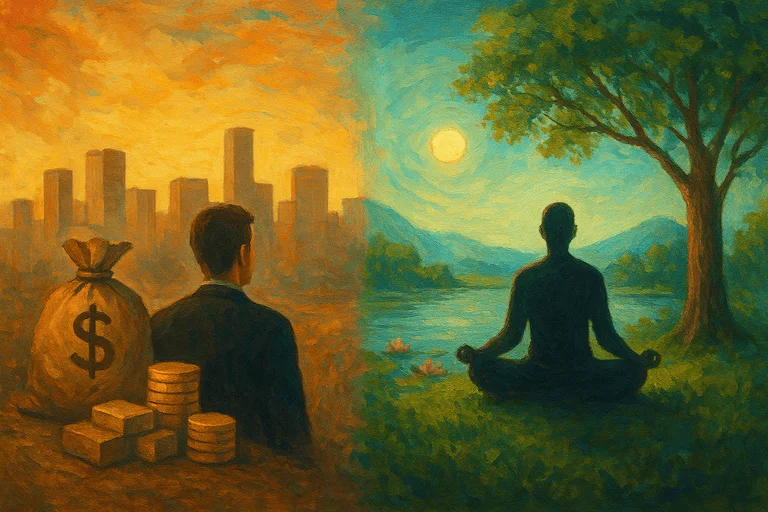
On the other hand, when materialism takes the lead, life becomes about accumulation rather than understanding. The Western world often celebrates success through possessions, titles, or social status. Spirituality becomes secondary, if not forgotten altogether. The result is a society rich in comfort but poor in peace.
Both extremes create imbalance. True growth requires both the inner and outer worlds to be in harmony.
Image
The Forgotten Wisdom of Integration
Historically, many ancient civilisations understood this balance. Societies in Egypt, India, Greece, and indigenous cultures across the world placed spiritual values at the centre of life while maintaining craftsmanship, trade, and scientific curiosity. The economy existed not as a separate force but as a reflection of moral and spiritual understanding.
We have largely lost that. Today, economics often operates without ethical grounding. The market rewards speed, competition, and growth at any cost, even if it exhausts people and the planet. In contrast, spirituality without practical systems to sustain life can remain idealistic but fragile.
A Vision for a New Society
I believe that we should move toward a society where spirituality once again stands as our foundation. This does not mean rejecting material life, but rather redefining its purpose. The economy should serve human growth, not the other way around. Imagine a system where success is measured not just by profit, but by collective wellbeing, education, compassion, and creativity.
In such a world, schools would teach not only logic and finance, but also mindfulness, philosophy, and ethics. Businesses would focus on meaningful impact rather than endless expansion. People would work to contribute, not just to consume.
Material progress should uplift the human spirit, not distract it. When managed with wisdom, the material world becomes a platform for spiritual development. Abundance and peace can coexist when guided by moral clarity and awareness.
The Path Forward
Rebuilding this balance requires both individual and collective effort. It begins with awareness: recognising that neither spirituality nor material life can flourish in isolation. As individuals, we can start by questioning what we prioritise each day. Do our choices lead to inner peace or only external comfort?
Communities and organisations can also reflect these values by creating systems that support mindfulness, connection, and sustainability. Platforms like Mindful Family are already working toward this vision by blending personal development, mindfulness, and community learning into everyday life.
Closing Thought
A healthy society is not one that is endlessly productive, but one that is peaceful, creative, and grounded in values. Spirituality should not be a luxury for the few, nor an escape from the material world. It should be the compass that guides it.
If we can build a world where spirituality is once again the foundation and material life flows in service of it, we may finally find the balance humanity has been searching for — a civilisation both enlightened and alive.