We use cookies to enhance your browsing experience, serve personalized content, and analyze our traffic. By clicking "Accept", you consent to our use of cookies.
Launch offer - Professional memberships are free for a limited time!
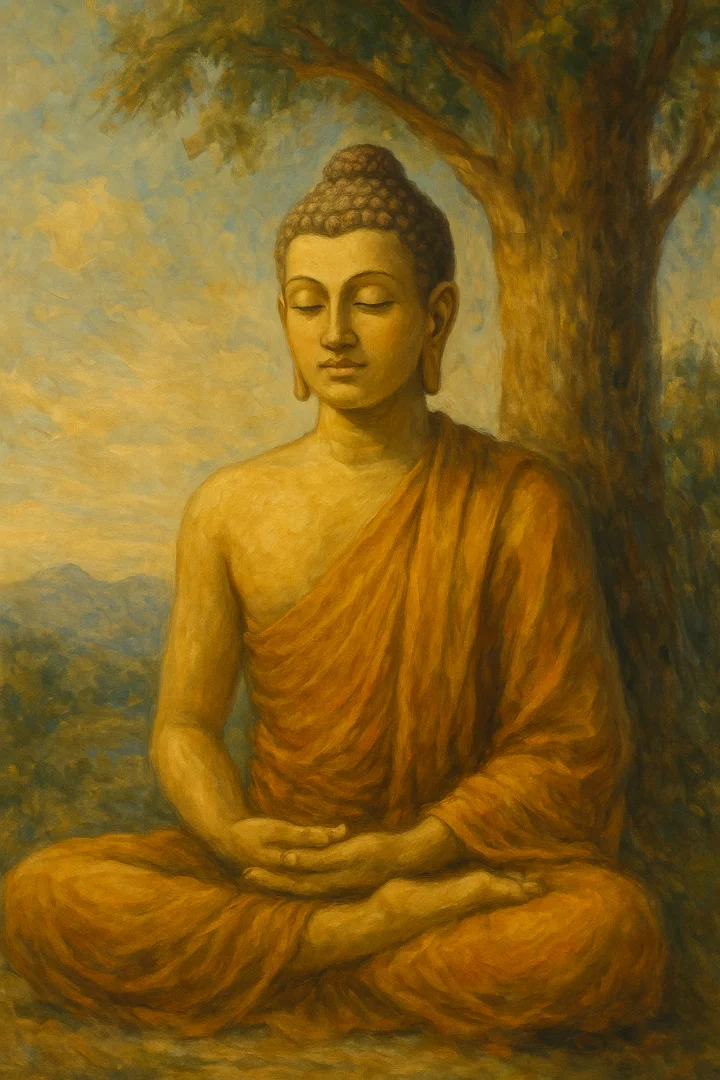
The Hidden Depth of Early Buddhism: Rediscovering the Real Meaning of the Tilakkhaṇa
The Buddha’s original teaching was never meant to be a religion or a ritual system. It was a precise description of reality, a clear explanation of how suffering arises and how it can end. Over centuries, many of these meanings became blurred or simplified. Words that once carried deep insight were translated into something shallow and literal. One of the clearest examples is the set of three universal characteristics known as Tilakkhaṇa: anicca, dukkha, and anatta.
The Common Misunderstanding
Most people are taught that:
- Anicca means impermanence.
- Dukkha means suffering.
- Anatta means there is no self.
These definitions are only partial. According to deeper early interpretations, they miss the true insight that leads to liberation. The Buddha was not simply saying that everything changes or that life is suffering. He was pointing to a profound realisation about the nature of experience and the impossibility of finding lasting satisfaction in anything that depends on conditions.
The Real Meaning of Anicca
In its original sense, anicca means the inability to maintain anything the way we desire, no matter how hard we try. It is not just that things decay or change, but that all conditioned experiences are ultimately uncontrollable.
We build careers, relationships, and identities believing we can make them last or behave according to our wishes. Inevitably, reality does not cooperate. That failure to keep things stable brings frustration and restlessness.
When we truly see anicca, we understand that nothing in the world can provide ultimate refuge. This realisation naturally softens attachment and craving, which are the root causes of suffering.
The Real Meaning of Dukkha
In this context, dukkha does not simply mean pain. It means the unsatisfactory nature of all existence that depends on conditions. Because things are anicca, they cannot give permanent happiness. Even pleasant experiences carry a hidden discomfort, the tension of knowing they will not last.
Seeing this clearly changes how we relate to life. We stop clinging to moments of pleasure as if they could save us. Instead, we start to experience a quiet peace that does not depend on circumstances.
The Real Meaning of Anatta
Perhaps the most misunderstood of all, anatta does not mean that there is no self at all. It means that there is nothing worth taking as “mine” or “me” because nothing can be controlled or made permanent. The word points to the absence of true ownership or mastery.
When we believe we can control things, whether our body, emotions, possessions, or other people, we suffer endlessly. Seeing anatta is recognising that all these things operate according to natural causes and conditions. The sense of “I” and “mine” loses its grip, and with it, suffering begins to fade.
Why These Meanings Were Lost
As Buddhism spread through different cultures, the original experiential meanings were replaced by abstract philosophical ideas. Anicca became a simple statement of impermanence, dukkha became a synonym for unhappiness, and anatta was reduced to a metaphysical claim about the absence of a soul.
These simplifications made Buddhism easier to teach but stripped it of its psychological precision. Without understanding the deeper implications of anicca, dukkha, and anatta, meditation becomes a relaxation exercise rather than a path to liberation.
A Science of the Mind, Not a Belief System
The Buddha’s insight was not about faith but about natural law. He discovered that everything arises and fades according to causes, a process called Paṭicca Samuppāda. This law of dependent origination explains how craving, attachment, and ignorance perpetuate the cycle of rebirth and suffering.
Seeing the world through the lens of anicca, dukkha, and anatta allows one to break that cycle. It shifts perception from grasping to understanding, from control to acceptance.
Bringing It Into Daily Life
You do not need to become a monk or withdraw from the world to experience these truths. Every moment of frustration, desire, or loss is an opportunity to observe anicca in action. Every time you recognise the restlessness of wanting things to be different, you glimpse dukkha. Every time you realise that trying to control life only deepens the tension, you experience anatta.
This is what the Buddha meant by wisdom. It is not intellectual but experiential, a quiet seeing that dissolves ignorance.
Why It Was Hidden for So Long
The early meanings of these teachings were preserved mainly in Pāli texts and oral traditions. Over centuries, translation, ritualisation, and cultural adaptation turned them into simplified doctrines. The original focus on direct experience was overshadowed by philosophy, devotion, and ceremony.
Only in recent decades have scholars and practitioners begun revisiting the early teachings to uncover the psychological precision that the Buddha intended. These rediscoveries show that Buddhism is not a religion of belief but a science of the mind, capable of explaining suffering and its end in practical, observable terms.
Conclusion
The Buddha’s teaching is not about detaching from life but about seeing it clearly. Anicca, dukkha, and anatta describe the laws that govern our experience, the reason we suffer, and the way we can be free.
When we understand them as the Buddha meant them, they stop being abstract concepts and become living insights. They remind us that everything we cling to will shift, that all worldly satisfaction is temporary, and that freedom begins when we stop trying to own what cannot be owned.
The truth was never lost; it was hidden under misunderstanding. To uncover it, we do not need new beliefs, only the courage to observe reality as it is.